
Managing Dental Anxiety with Animal-Assisted Therapy
The following is a synopsis of the article, “Animal-assisted therapy for fear and anxiety management during pediatric dental treatment: case reports,” which appears in the May/June 2026 issue of General Dentistry. Read the full article here.
Animal-assisted therapy (AAT) can offer comfort in healthcare settings, especially in pediatric care, where emotional support plays a crucial role in patients’ experiences and cooperation during treatment. In a new study in the May/June issue of General Dentistry, Schlesinger et al evaluate the potential benefits of AAT by comparing the fear and behavior demonstrated by two anxious children during dental procedures performed with and without adjunctive AAT.
AAT has long provided physical, emotional and social support to patients in healthcare settings.(1) Dogs are the most commonly involved animals in AAT. They can be petted, hugged or just observed by patients. Guidelines emphasize the importance of good training and periodic health evaluations of the animals, and the animal’s coach must be present at all times.(2)
It has been reported that AAT has many benefits across all age groups, including alleviation of pain, stress and anxiety, as well as a positive impact on communication among healthcare teams, patients and families.(3,4) Although the use of AAT in dentistry is less explored, it can offer significant benefits, especially in pediatric care.(1,5)
Case reports
The patients were a 4-year-old boy and a 7-year-old girl, both of whom had extensive cavitated caries lesions requiring treatment. Beginning with initial evaluations, both patients cried and exhibited signs of fear, refusing dental treatment, despite application of behavioral management techniques such as tell-show-do and positive reinforcement. After multiple sessions, no significant progress was observed in controlling the stress and anxiety reported by the children. As a result, the option of utilizing AAT was discussed with the guardians. Both patients were familiar with dogs and did not exhibit signs of fear or object to animals.
For both patients, the first dental treatment session was concluded without the presence of animals, and ATT was implemented during the second appointment. During AAT, two properly trained and certified dogs were handled by a volunteer coach. The health of all animals in the AAT program is monitored by veterinarians.
Throughout AAT, the dental clinic adhered to standard procedures for biological risk prevention, disinfection and physical barriers, and the professionals responsible for operative treatments had no physical contact with the dogs. A dog was positioned between the patient’s legs, maintaining an approximate distance of 80 cm from the head to ensure biosafety within the operative field. The dog’s coach remained beside the patient, ensuring the animal’s physical safety and observing its behavior throughout the procedure.
Multiple methods were used to evaluate the effect of AAT on the children’s anxiety and behavior. Salivary cortisol levels were measured at all consultations.(6) In addition, the patients used the Facial Image Scale—a simple chart showing emotions ranging from very happy to very unhappy—to indicate their feelings at the beginning and end of treatment.(7) Patient behavior was classified by a trained observer using the Venham Behavior Rating Scale, which has scores ranging from 0 for acceptable behavior (total cooperation) to 5 for unacceptable behavior.(8)
The salivary cortisol levels and scores on the Facial Image Scale and Venham Behavior Rating Scale were compared to determine differences between the appointments. The individual results for both children indicated reductions in levels of fear and anxiety as well as improved behavior during treatment sessions incorporating AAT. The cortisol levels at the end of treatment performed without AAT were higher than those at the beginning, suggesting that treatment increased the children’s stress levels. Conversely, in sessions with AAT, salivary cortisol levels were lower after treatment than before treatment. Using the Facial Image Scale, both patients reported feeling less happy at the end of their conventional appointment. During AAT sessions, both patients reported feeling very happy both before and after treatment, suggesting that their emotions were influenced by the presence of dogs in the clinical environment from the beginning of the appointment. In addition, the clinical observer found that both patients’ behavior changed from unacceptable throughout their first treatment appointment to totally cooperative by the end of the AAT appointment.
At the conclusion of the procedures conducted with AAT, the patients were allowed to interact freely with the animals (Figure). Following AAT sessions, the dental team observed a positive influence on the behavior of both patients during subsequent conventional appointments.
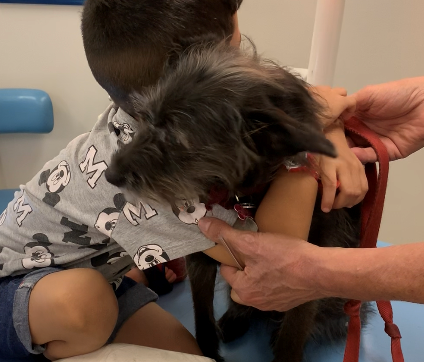
Figure. Unrestricted interaction between the patient and dogs after clinical treatment.
Discussion
AAT has proven to be an effective tool for controlling stress and anxiety in medical and hospital settings, but it remains a relatively unexplored technique in dentistry. The objective of this article was to evaluate the fear and cooperation of two children undergoing dental treatment with or without the application of AAT. The results suggested anxiety reduction and improved behavior by the children during AAT, as well as a notable positive influence on the patients in subsequent appointments, confirming the potential of this noninvasive technique for behavioral management in pediatric dentistry.
Other studies have confirmed the potential of AAT in controlling anxiety during restorative treatments for children who like dogs.(1) AAT should be avoided for children who report fear or aversion to dogs, patients with allergies or altered immunity, very young children and immunocompromised patients.
Well-designed studies are essential to establish the efficacy of AAT in dentistry and to gain the trust of dental professionals and guardians. However, challenges remain, including concerns regarding the potential risk of contamination. Despite the biosafety limitations and concerns, a close partnership between the teams at the dental clinic and the AAT program ensured the success of the experience in the present study.
Conclusion
The application of AAT in dentistry, particularly pediatric dentistry, shows promising results for noninvasive behavioral management. The experiences of the two pediatric patients described in this report suggest that AAT could help to control pain and stress as well as improve the behavior of children during dental procedures.
References
- Cruz-Fierro N, Vanegas-Farfano M, González-Ramírez MT. Dog-assisted therapy and dental anxiety: a pilot study. Animals (Basel). 2019;9(8):512. doi:10.3390/ani9080512
- American Veterinary Medical Association. Animal-assisted interventions: guidelines. 2020. Accessed March 19, 2026. https://www.avma.org/resources-tools/animal-health-and-welfare/service-emotional-support-and-therapy-animals/animal-assisted-interventions-guidelines
- Mandrá PP, Morreti TCDF, Avezum LA, Kuroishi RCS. Animal assisted therapy: systematic review of literature. Codas. 2019;31(3):e20180243. doi:10.1590/2317-1782/20182018243
- Waite TC, Hamilton L, O’Brien W. A meta-analysis of animal assisted interventions targeting pain, anxiety and distress in medical settings. Complement Ther Clin Pract. 2018;33:49-55. doi:10.1016/j.ctcp.2018.07.006
- Morales-Chávez MC, López-Labady J. Urine cortisol levels in children before dentistry consultation to measure the presence of anxiety: a cross-sectional study. Pesqui Bras Odontopediatr Clin Integr. 2017;17(1):e3818. doi:10.4034/pboci.2017.171.55
- Jorge SR, Santos PB, Stefanello JMF. O cortisol salivar como resposta fisiológica ao estresse competitivo: uma revisão sistemática. Rev Educ Fis UEM. 2010;21(4):677-686. 10.4025/ reveducfis.v21i4.9053
- Buchanan H, Niven N. Validation of a Facial Image Scale to assess child dental anxiety. Int J Paediatr Dent. 2002;12(1):47-52. doi:10.1046/j.0960-7439.2001.00322.x
- Cademartori MG, Da Rosa DP, Oliveira LJ, Corrêa MB, Goettems ML. Validity of the Brazilian version of the Venham’s Behavior Rating Scale. Int J Paediatr Dent. 2017;27(2):120-127. doi:10.1111/ipd.12231